Orvanta Pest GuardOrvanta Pest Guard

Seasonal Mosquito and Tick Suppression Louisville

Louisville’s geographic placement along the Ohio River basin creates sustained humidity, while dense mature canopies in neighborhoods like The Highlands, Crescent Hill, and Cherokee Park produce prime breeding…
Get My Free Estimate →(270) 400-2488
Seasonal Mosquito and Tick Suppression in Louisville, KY
Quick answer
  • Scope: 21 to 30-day targeted perimeter misting, dense foliage applications, standing water larvicide dunks, and leaf litter barrier treatments.
  • Timing: Scheduled intervals every 3 to 4 weeks during active breeding weather, typically between April and October in Jefferson County.
  • Rates: Seasonal yard packages begin at the $250 baseline minimum per single application, with precise costs determined by property acreage and canopy density on-site.
  • Targets: Aedes albopictus (Asian tiger mosquito), Culex mosquitoes, Ixodes scapularis (blacklegged deer tick), and Amblyomma americanum (lone star tick).
  • Scheduling: Inspections and barrier applications coordinate by calling (270) 400-2488.

Louisville’s geographic placement along the Ohio River basin creates sustained humidity, while dense mature canopies in neighborhoods like The Highlands, Crescent Hill, and Cherokee Park produce prime breeding conditions for *Aedes albopictus* and *Culex* mosquitoes. Properties situated near drainage corridors, Beargrass Creek, or the heavily wooded borders of Iroquois Park and Locust Grove experience intense mosquito proliferation once soil temperatures remain above 50°F. Concurrently, blacklegged deer ticks thrive within the unmanaged leaf litter and brush edges common in Clifton and eastern Jefferson County. Standard retail foggers degrade rapidly under rainfall and ultraviolet exposure, failing to interrupt the 7 to 10-day reproduction cycle of local vectors.

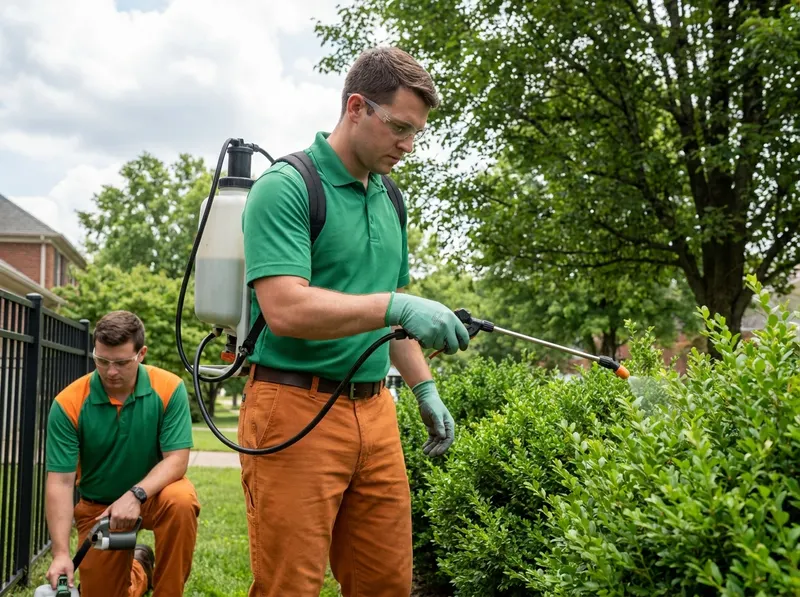
The suppression methodology utilizes the Orvanta Guard System, deploying microencapsulated botanical-synthetic polymer barriers to the undersides of broadleaf plants, boxwoods, low-hanging tree branches, and groundcover. These formulations bond to vegetation surfaces, resisting rainfall wash-off for up to 30 days while remaining non-systemic to deep root systems. For standing water zones that cannot be mechanically drained, such as retention ponds in Jeffersontown, catch basins in Shively, or low-lying ornamental water features in St. Matthews, microbial larvicide applications containing *Bacillus thuringiensis israelensis* (BTI) eliminate mosquito larvae within 24 hours without disrupting non-target aquatic life.

Property owners evaluating single-event sprays versus continuous seasonal suppression face distinct operational trade-offs. A one-time event treatment provides a rapid adult knockdown suitable for a weekend gathering, but it does not intercept subsequent hatch cycles emerging from damp soil or untreated perimeter pockets. Comprehensive seasonal suppression requires re-application every 21 to 28 days to break overlapping larval transitions, demanding a sustained schedule rather than a reactive one. While open grassy lawns in Pleasure Ridge Park require straightforward perimeter fence-line sprays, historic multi-tier gardens in Old Louisville and urban lots in Germantown or Portland demand hand-applied precision mists to avoid pollinator-heavy flowering beds, slightly increasing application duration.

Seasonal Mosquito and Tick Suppression cost in Louisville

Baseline Single-Event Barrier Mist (Up to 0.25 Acre)$250, $325
Standard Residential Property Treatment (0.25 to 0.5 Acre)$250, $375
Extended Acreage Yard Suppression (0.5 to 1.0 Acre)$350, $550
Full Seasonal Program (7-Visit Cycle, April, October)$1,750, $2,600

Every job gets a firm, written price after a free on-site visit.

Common questions

How long after a mosquito treatment in Louisville can children and dogs enter the yard?
Exterior areas are safe for children and domestic pets once the liquid barrier formulation has completely dried, which requires 30 to 45 minutes under standard Louisville summer humidity.
How does rainy weather in Jefferson County affect seasonal tick suppression treatments?
Microencapsulated barrier formulations bind directly to organic matter within 60 minutes of application, allowing the residual tick deterrent to withstand normal Jefferson County rainfall without washing out.
Does mosquito suppression eliminate pollinating bees and butterflies in residential gardens?
Technicians intentionally avoid spraying flowering plants, vegetable gardens, and active blossom clusters, directing the micro-droplets exclusively to resting surfaces like non-flowering foliage undersides, foundation brush, and dense ivy.
What distinguishes seasonal mosquito suppression from standard quarterly pest control in Louisville?
Standard quarterly service targets crawling perimeter invaders like ants and spiders around structural foundations, whereas seasonal suppression focuses specifically on exterior air space, vegetation canopies, standing water, and organic soil litter across the entire yard boundary.
How are properties with standing water or decorative ponds in Louisville handled?
Standing water features that cannot be drained are treated with biological BTI larvicide dunks that target mosquito pupae and larvae exclusively, leaving ornamental fish, amphibians, and plants unharmed.
Helpful resources

Trusted references & local links

USA.gov, government & consumer helpBetter Business BureauFTC Consumer AdviceU.S. Small Business AdministrationReady.govU.S. EPAENERGY STARU.S. Dept. of EnergyConsumer.govU.S. Census BureauGoogle Maps, Louisville, KY

Get started today

Tell us about your seasonal mosquito and tick suppression job in Louisville and we'll send a clear, written quote, usually the same day.

Get your free pest control services quote, Louisville

We only use your ZIP to check availability, no spam.